

Vosotros meaning is simple once you see it. Vosotros is a Spanish word that means “you all” or “you guys.” It is an informal plural pronoun. You use it when you talk to a group of friends, family, or peers. People in Spain use it every day. Many learners in the US never hear it in class, so it feels strange at first. That is why the word confuses so many people. Some books teach it. Some skip it. Apps often treat it as optional. In this guide, you will learn what vosotros means, where it is used, and how its verbs work. You will also see easy examples. By the end, you will feel ready to spot it and use it with confidence.
Vosotros means “you all” in Spanish. It is the informal plural form of “you.” People in Spain use it with friends, family, and classmates. In most of Latin America, people say ustedes instead. The word has its own verb endings, like habláis and coméis. It also has a feminine form, vosotras, for groups made up only of women.
Vosotros Meaning in Simple Words
The vosotros meaning in English is “you” for more than one person. Think of “you all,” “you guys,” or “y’all.” Spanish has two ways to say “you” when you speak to a group. One is formal. The other is informal. Vosotros is the informal one.
Say you are chatting with three friends in Madrid. You might ask, “¿Vosotros queréis pizza?” That means, “Do you all want pizza?” Nothing in that sentence is rude or tricky. It is just a friendly way to speak to a group.
The word has a feminine form too. Use vosotras for a group of women only. A mixed group uses vosotros.
Part of Speech and Grammar Rules
Vosotros is a subject pronoun. It is also a second-person plural pronoun. That means it points to the people you are speaking to, and there is more than one of them.
Spanish verbs carry the subject inside their endings. So native Spanish speakers often drop the pronoun. “Habláis rápido” already tells you who is speaking. People add vosotros when they want to stress the group or avoid confusion.
Vosotros has a few close relatives. Os is the object pronoun. “Os veo mañana” means “I see you all tomorrow.” Vuestro is the possessive. “Vuestra casa” means “your house” when the owners are a group. After a preposition, you keep the full word, as in “para vosotros.”
How to Pronounce Vosotros
Say it as boh-SOH-trohs. The stress falls on the middle syllable. Spanish vowels are short and clean. So the o sounds like the o in “go,” but without the glide English adds.
The r in “tros” is a quick tap of the tongue. It is not the English r. Say the s at the end clearly. Do not drop it.
Try saying it slowly three times. Then speed up. Listening to native Spanish speakers helps a lot. Short audio clips from Spain are a great place to start.
Origin and History of Vosotros
The history explains the vosotros meaning well. The word was built from two parts. The first is vos, which comes from the Latin word vos. In Latin, it meant “you” for many people. The second part is otros, which means “others.” That word comes from the Latin word alter, meaning “other.”
So the word first felt like “you others.” The longer shape helped show that the speaker meant a group.
Other languages made similar words. Catalan has vosaltres. Galician has vosoutros. Italian has voialtri. French has vous autres. This pattern was shared across the Romance languages.
Here is a fun twist. The short form vos did not vanish. In some Latin American countries, it became a singular informal pronoun. You will see that in a moment.
Where People Use Vosotros
In Spain
Vosotros is part of daily talk in most of Spain. People use it with friends, family, classmates, and coworkers they know well. Many learners call Spain’s standard speech Castilian Spanish, and vosotros is a key part of it.
Not every area follows this rule. In parts of southern Spain and most of the Canary Islands, speakers often use ustedes with the same group of people. Regional dialects shape how people talk, even inside one country.
In Latin America
In Latin America, vosotros is rare in everyday speech. People use ustedes for every group, formal or casual. You may still see vosotros in speeches, legal texts, and religious texts. Some references also list Equatorial Guinea and the Philippines as places where it appears in daily speech.
A pronoun can say a lot about where someone is from. For many speakers, it is part of cultural identity.
Vosotros vs Ustedes
Both words mean “you all.” The difference comes down to region and tone.
In Spain, vosotros is informal and ustedes is formal. You might say vosotros to a group of friends. You might say ustedes to a group of customers or older strangers.
In Latin America, ustedes does both jobs. It works for friends, family, and strangers alike. That is why most classroom Spanish in the US teaches ustedes first.
The verbs also differ. Ustedes takes the same verb form as “they.” Vosotros has its own form.
- Ustedes hablan. (You all speak.)
- Vosotros habláis. (You all speak.)
If you are unsure, ustedes is a safe choice almost anywhere. People in Spain will understand it. It may just sound a bit formal with close friends.
Read Related Post: PS Meaning in Text: What It Really Means in Messages, Social Media, and Everyday Chats
Vosotros vs Tú and Vos
Tú means “you” for one person in informal speech. Vosotros is the plural partner. In Spain, they work as a pair.
- Tú eres amable. (You are kind.)
- Vosotros sois amables. (You all are kind.)
Vos is a different story. It is a regional singular pronoun. People use it in places like Argentina and Uruguay, and it replaces tú there. For example, an Argentine speaker may say, “Vos sos mi amigo.”
Because the words look alike, learners mix them up. Here is a small memory trick. Vosotros has “otros” inside it. “Others” means more than one. So vosotros is always plural.
Vosotros Conjugation and Verb Endings
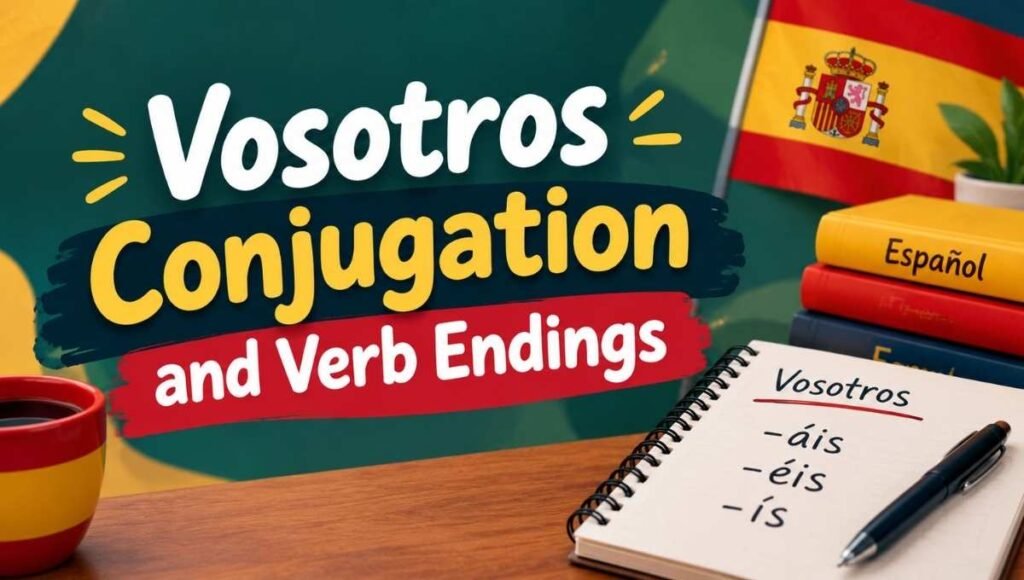
Spanish verb conjugation can feel heavy. The good news is that vosotros follows a clean pattern in the present tense. Drop the ending from the verb. Then add the new ending.
| Verb | New ending | Vosotros form | Meaning |
| hablar | -áis | habláis | you all speak |
| comer | -éis | coméis | you all eat |
| vivir | -ís | vivís | you all live |
In the past tense, the endings change again. Hablar becomes hablasteis, comer becomes comisteis, and vivir becomes vivisteis.
Irregular Verbs
A few verbs break the pattern. The big ones are sois (from ser) and vais (from ir). You will use them often, so they are worth memorizing early.
Here is a tip that saves time. Verbs that change their stem in other forms keep a steady stem with vosotros. Querer becomes queréis, not “quieréis.” Poder becomes podéis, not “puedéis.” That makes this form easier than it looks.
What Vosotros Sois, Estáis, and Tenéis Mean
Some vosotros forms show up in almost every conversation. Here is what they mean.
- Vosotros sois means “you all are.” Use it to say who or what the group is.
- Vosotros estáis also means “you all are.” Use it for places, moods, and short states.
- Vosotros tenéis means “you all have.”
- Vosotros vais means “you all go.”
- Vosotros habláis means “you all speak.”
- Vosotros podéis means “you all can.”
- Vosotros sabéis means “you all know.”
- Vosotros queréis means “you all want.”
- Vosotros hacéis means “you all do” or “you all make.”
Spanish has two verbs for “to be,” so sois and estáis can confuse new learners. The vosotros meaning stays the same. Only the type of “being” changes.
Examples of Vosotros in Sentences
Seeing the word in action makes it stick. Here are some Spanish sentence examples with simple English translations.
- Vosotros sois mis mejores amigos. (You all are my best friends.)
- ¿Vosotros estáis listos para la fiesta? (Are you all ready for the party?)
- Vosotros tenéis mucho talento. (You all have a lot of talent.)
- ¿Vosotros vais al cine esta noche? (Are you all going to the movies tonight?)
- Vosotros habláis muy bien español. (You all speak Spanish very well.)
- ¿Podéis ayudarme con la tarea? (Can you all help me with the homework?)
- Vosotros sabéis la respuesta. (You all know the answer.)
- Os quiero mucho. (I love you all very much.)
- Vosotros hacéis la cena hoy. (You all are making dinner today.)
Notice that “¿Podéis ayudarme?” has no pronoun. The verb ending already shows who is speaking. That is very common in real talk.
Synonyms and Alternatives for Vosotros
Vosotros has no perfect synonym. Its closest partner is ustedes. Its closest opposite is tú, since tú is singular. The table below shows how these words connect.
| Word | How it relates | Quick note |
| ustedes | Plural alternative | Used for all groups in Latin America. Formal in Spain. |
| vosotras | Feminine form | Used for groups of women only. |
| tú | Singular contrast | One person, informal. |
| usted | Singular formal | One person, shows respect. |
| vos | Regional singular | Common in Argentina and Uruguay. |
| nosotros | “We” | Built the same way, with “otros” at the end. |
Related Words and Phrases
A few small phrases use vosotros all the time.
- Vosotros mismos means “you yourselves.”
- Entre vosotros means “among you all.”
- Con vosotros means “with you all.”
- A vosotros means “to you all.”
Common Mistakes Learners Make
Most errors come from mixing systems. Here are the ones to watch.
- Using vosotros in Latin America. It may sound odd there. Ustedes fits better.
- Mixing the pronoun and the verb. “Vosotros hablan” is wrong. Use “vosotros habláis” or “ustedes hablan.”
- Confusing vosotros with vos. One is plural. The other is a regional singular.
- Changing the stem by habit. Say “queréis,” not “quieréis.”
- Forgetting os. “Os veo” is the right object form, not “los veo,” when you mean “you all” in Spain.
How to Use Vosotros in Daily Life
Start with the setting. Use vosotros in group conversations with friends and family in Spain. It fits casual language best. For formal communication, such as a work email to a team you do not know well, ustedes is the better pick.
Practice in small steps. First, learn the three basic endings: -áis, -éis, and -ís. Next, add the common irregular forms, such as sois and vais. Then say a few sentences out loud each day.
Good Spanish learning resources help here. Watch a show filmed in Spain. Listen to a podcast from Madrid or Barcelona. Notice how often the vosotros endings pop up. Language learning works best when you hear the word in real speech.
Do you need it? That depends on your goals. If you plan to live, study, or travel in Spain, yes. You will hear it every day. If you focus on Latin America, you can understand it without using it. Still, knowing it makes you a stronger reader and listener.
Frequently Asked Questions
What does vosotros mean in English?
It means “you all” or “you guys.” It speaks to more than one person in an informal way.
Is vosotros formal or informal?
It is informal. Use it with people you know well. For a formal group, Spanish in Spain uses ustedes.
Why do Spanish verbs change with vosotros?
Spanish verbs change endings to show who does the action. Vosotros has its own ending, so listeners know you mean a group of peers.
Is vosotros used in written Spanish?
Yes, in Spain it appears in books, messages, and articles. Elsewhere, it mostly shows up in speeches, legal texts, and religious texts.
Can you speak Spanish without learning vosotros?
Yes. Ustedes works in most places, and people will understand you. Still, learning vosotros helps you follow Spanish speakers from Spain.
Conclusion
The vosotros meaning is easy to hold on to. It is the informal “you all” of Spanish, used mostly in Spain. It has its own verb endings, a feminine form, and a clear link to the words os and vuestro.
You do not need it everywhere. But learning it helps you listen better and read more. Start small, practice with real examples, and enjoy the process. Soon vosotros will feel like a natural part of your Spanish.

